In this edition, PhiloTalk invites the Indonesian philosophical public—particularly those who aspire to construct a philosophical system that “distinguishes itself” from the dominant currents of Western philosophy—to critically re-examine such an ambition. As a philosophical public shaped by a postcolonial space and temporality, are our ways of doing philosophy and imagining the future of Indonesian/Nusantara philosophy inevitably influenced by the shadow of subalternity and the discourse of “resistance”?
This session seeks to introduce the discourse of Peripheral Philosophy through three key questions: • What is meant by peripheral philosophy, and why is it significant for the philosophical ecosystem in a postcolonial context? • How does peripheral philosophy approach the project of decolonizing knowledge? • Does a peripheral condition necessarily give rise to a philosophy of resistance and emancipatory praxis?
To address these questions, we are pleased to welcome two speakers: • Katarzyna Bielińska (University of Warsaw) • Rangga Kala Mahaswa (Universitas Gadjah Mada & University of Glasgow)
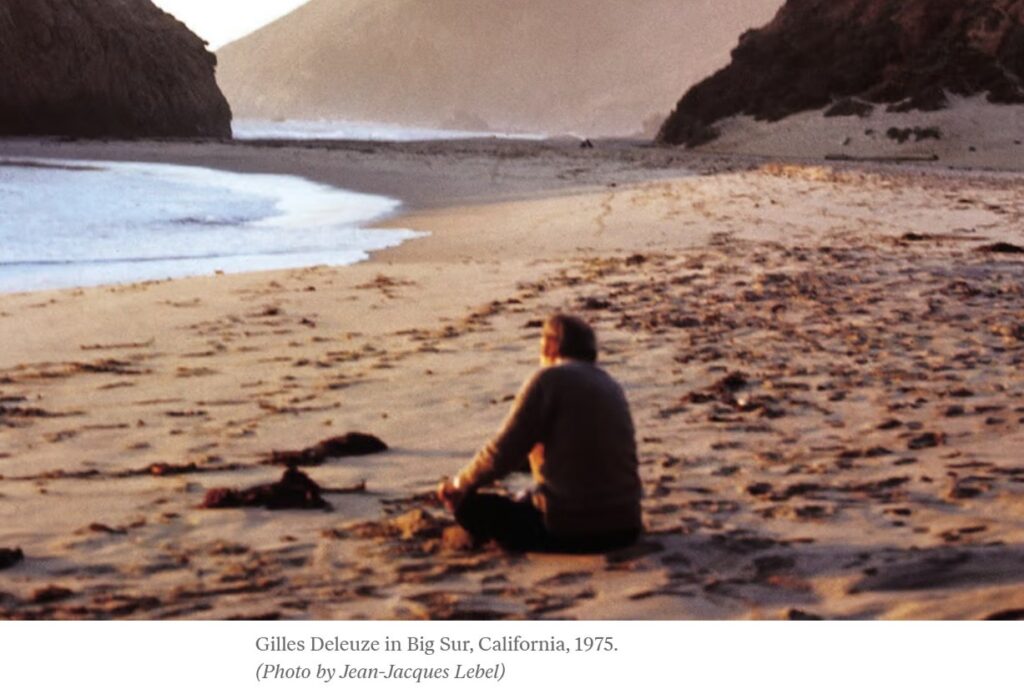
Throughout 2026, we will convene an intensive reading group dedicated to revisiting the thought of one of the most influential philosophers within the broader horizon of geophilosophy, Gilles Deleuze. Deleuze’s intellectual project unfolds across a remarkably wide terrain, engaging with philosophy, politics, art, law, technology, and science.
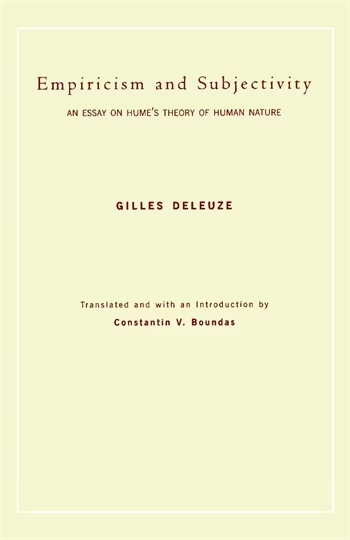
Reading Materials: Empiricism and Subjectivity: An Essay on Hume’s Theory of Human Nature
Throughout 2026, we will convene an intensive reading group dedicated to revisiting the thought of one of the most influential philosophers within the broader horizon of geophilosophy, Gilles Deleuze. Deleuze’s intellectual project unfolds across a remarkably wide terrain, engaging with philosophy, politics, art, law, technology, and science.
Reading Materials: Empiricism and Subjectivity: An Essay on Hume’s Theory of Human Nature
Three: The Power of the Imagination in Ethics and Knowledge (pp. 55-72)
Throughout 2026, we will convene an intensive reading group dedicated to revisiting the thought of one of the most influential philosophers within the broader horizon of geophilosophy, Gilles Deleuze. Deleuze’s intellectual project unfolds across a remarkably wide terrain, engaging with philosophy, politics, art, law, technology, and science.
Reading Materials: Empiricism and Subjectivity: An Essay on Hume’s Theory of Human Nature
Translator’s Introduction: Deleuze, Empiricism, and Struggle for Subjectivity (pp. 1-20)
One: The Problem of Knowledge and the Problem of Ethics (pp. 20-36)
This public lecture explores the vital transition of Indigenous epistemologies from global invisibility to scholarly recognition. Examines how intercultural hermeneutics can validate Indigenous perspectives as original and non-derivative knowledge, offering a critical yet respectful framework for global engagement without compromising their unique cultural essence.
Tuesday, 30 September 2025
Faculty of Philosophy, Universitas Gadjah Mada
Speakers:
Prof. Prasenjit Biswas
(Professor of Philosophy, North Eastern Hill University, Shillong, India)
Rangga Kala Mahaswa, M.Phil
(Faculty of Philosophy, Universitas Gadjah Mada, Indonesia)
Throughout 2026, we will convene an intensive reading group dedicated to revisiting the thought of one of the most influential philosophers within the broader horizon of geophilosophy, Gilles Deleuze. Deleuze’s intellectual project unfolds across a remarkably wide terrain, engaging with philosophy, politics, art, law, technology, and science. We believe that this rereading initiative provides an opportunity to critically reassess Deleuze’s well-established ideas, including those that have shaped influential traditions of thought, while also bringing renewed attention to the more subtle and potentially underexamined aspects of his works. In doing so, the program aims to position Deleuzian thought as a compelling alternative framework for engaging with contemporary academic challenges and climates.
The program will examine each of Deleuze’s major works, including those written in collaboration with Félix Guattari. Nevertheless, the discussion will not encompass writings prior to 1953 that are generally regarded as non-canonical, consisting:
Description de la femme: Pour une philosophic d’Autrui sexuee ‘Description of the woman: For a philosophy of the sexual Other’ (1945)
Du Christ à la bourgeoise ‘From Christ to the bourgeois’ (1946)
Mathese, Science et Philosophie ‘Mathematics, Science and Philosophy’ (1946)
Dires et profils ‘Sayings and profiles’ (1946)
Introduction to Denis Diderot (1947)
David Hume, sa vie, son oeuvre, avec un exposé de sa philosophie ‘David Hume, his life, his work, with an exposition of his philosophy’ (1952)
Posthumously published collections of essays, e.g. Desert Islands and Other Texts 1953–1974 (2004) and Two Regimes of Madness: Texts and Interviews 1975–1995 (2006), are not treated as the primary focus of the sessions. Instead, these texts serve as complementary materials alongside relevant secondary literature and commentary. Likewise, collections of interviews, e.g. Dialogues (1977) and Dialogues II (1987), function as supporting references rather than as central readings within the program.
All sessions will be conducted online and each meeting led by a designated speaker. Participants are expected to complete the assigned readings in advance to enable focused discussion. The sequence of readings follows Deleuze’s bibliographical trajectory, with each month dedicated to a different major work. For further information and meeting link, please contact us at organizers@cas-geo.org.
___________________________________________
April 2026 – Empiricism and Subjectivity: An Essay on Hume’s Theory of Human Nature (Columbia University Press, 2001)
Experience is a principle, which instructs me in the several conjunctions of objects for the past. Habit is another principle, which determines me to expect the same for the future, and both of them conspire to operate upon the imagination.
— David Hume, in A Treatise of Human Nature, p. 55
Nature and culture form, therefore, a whole or a composite. Hume repudiates the arguments which assign everything, including justice, to the instinct, and the arguments which assign everything, including the meaning of virtue, to politics and education. The former, as they forget culture, give us a false image of nature; the latter, as they forget nature, deform culture.
— Gilles Deleuze, in Empiricism and Subjectivity, p. 44
This work presents a bold reinterpretation of David Hume by arguing that empiricism is not simply a theory of knowledge grounded in sensory experience, but a philosophy explaining how subjectivity itself is produced. Drawing on A Treatise of Human Nature, Deleuze contends that the subject is not a pre-given unity but an effect emerging from associations of impressions, habits, and passions. Through principles of association and the formation of habit, fragmented experiences become organized into stable beliefs, expectations, and moral practices. In this sense, Humean empiricism reveals that the self, knowledge, and social order arise from processes within experience itself, positioning subjectivity as a dynamic and constructed product of relations rather than a foundational origin of thought.
Week 1
Convenor: Rangga Kala Mahaswa
Date and Time: Apr. 14, 2026 | 8 p.m. (GMT +7) or 2 p.m. (GMT +0)
Reading Materials:
Translator’s Introduction: Deleuze, Empiricism, and Struggle for Subjectivity (pp. 1-20)
One: The Problem of Knowledge and the Problem of Ethics (pp. 20-36)
Two: Cultural World and General Rules (pp. 37-54)
Week 2
Convenor: Albertus Arioseto Bagas Pangestu
Date and Time: Apr. 21, 2026 | 8 p.m. (GMT +7) or 2 p.m. (GMT +0)
Reading Materials:
Three: The Power of the Imagination in Ethics and Knowledge (pp. 55-72)
Four: God and the World (pp. 73-84)
Five: Empiricism and Subjectivity (pp. 85-104)
Week 3
Convenor: Gloria Bayu Nusa Prayuda
Date and Time: Apr. 28, 2026 | 8 p.m. (GMT +7) or 2 p.m. (GMT +0)
Reading Materials:
Six: Principles of Human Nature (pp. 105-122)
Conclusion: Purposiveness (pp. 123-134)
Additional Readings
Deleuze’s Fragmented Writings:
“Hume” (in Desert Islands and Other Texts 1953–1974, Semiotext(e), 2004, pp. 162-169)
“On Empiricism” (in Dialogues II, Columbia University Press, 2007, pp. 54-59)
“Chapter 2: Repetition for Itself” (in Difference and Repetition, Bloomsbury, 2014, pp. 93-170)
Commentaries:
M. R. M. Parrott, Empiricism and Subjectivity: Deleuze and Consciousness, Rimric Press, 2002
John Roffe, “David Hume”, in Deleuze’s Philosophical Lineage, Edinburgh University Press, 2005, pp. 67-86
Jeffrey A. Bell, Deleuze’s Hume: Philosophy, Culture and the Scottish Enlightenment, Edinburgh University Press, 2009
Russell Ford, Experience and Empiricism: Hegel, Hume, and the Early Deleuze, Northwestern University Press, 2022
Russell Ford, “A Kind of Science-Fiction: Deleuze and Hume”, in The Deleuzian Mind, Routledge, 2025, pp. 51-64